
Starting a business is often a dream for many, especially in today’s fast-paced world where the next big idea could change everything. However, what we don’t often hear about are the failed startups – those that didn’t quite make it but still shaped the entrepreneurial journeys of the people behind them. These stories aren’t about giving up, but about learning from mistakes, iterating, and coming back stronger.
In this blog, we’re going to dive into the failures of some of the most successful entrepreneurs out there. We’ll explore what went wrong, what they learned, and how they used those lessons to fuel their future successes.
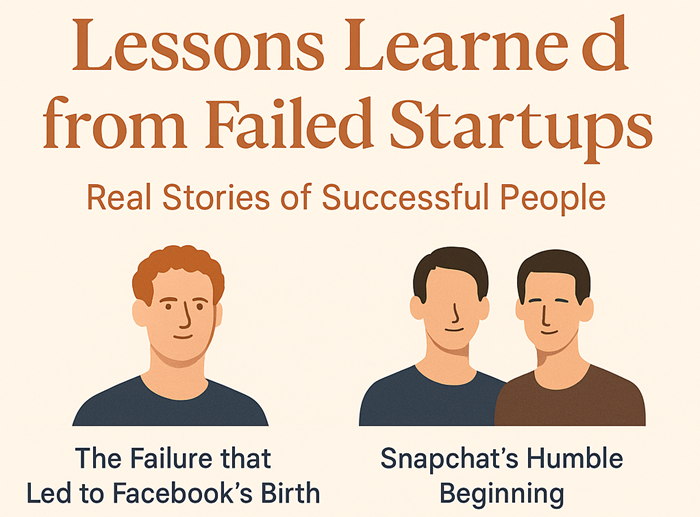
1. The Failure that Led to Facebook’s Birth – Mark Zuckerberg
Yes, we know, Facebook is the epitome of success today. But did you know that the first version of what would eventually become Facebook was called Facemash? Mark Zuckerberg’s initial idea was to create a website that compared the attractiveness of students at Harvard University by using their pictures. Sounds weird, right?
Facemash was shut down within days after it was discovered by the administration for violating privacy rules. Yet, from this failure, Mark learned a valuable lesson: understanding the value of user privacy and ethics. It pushed him to rethink the way he built platforms, which later contributed to Facebook’s success.
The takeaway? Failure is an opportunity to refine your idea. Sometimes, failure is a stepping stone towards an idea that resonates more deeply with your audience.
2. Snapchat’s Humble Beginning – Evan Spiegel and Bobby Murphy
Snapchat, one of the most popular social media platforms today, wasn’t always a hit. Evan Spiegel and Bobby Murphy faced major setbacks in the early days. In fact, their first version of Snapchat was initially dismissed as “just another messaging app” by investors. It didn’t help that Snapchat’s first attempt at a social media platform, called Picaboo, flopped and lost traction.
So, what did the duo learn? They learned that staying true to your core vision is key. Snapchat rebranded itself, focusing on disappearing messages – a feature that now defines the platform. The duo never gave up on the idea, even when faced with rejection. And eventually, their perseverance paid off.
The takeaway? Don’t be afraid of reinventing yourself. Rejection is part of the journey, but don’t let it stop you from pushing forward with what you believe in.
3. Ola’s Humble Beginnings – Bhavish Aggarwal
We all know Ola as one of India’s largest ride-hailing services today. But few people know that its co-founder, Bhavish Aggarwal, initially started with a completely different idea. He first tried launching a travel company where customers could rent out chauffeur-driven cars for long trips. The startup failed miserably.
Despite the failure, Bhavish didn’t give up. He pivoted from that business idea to create Ola. One of the most significant lessons he learned was the importance of listening to customer feedback. During his travels, he realized the need for on-demand, affordable rides and set out to fill that gap.
The takeaway? Fail fast, but fail smart. Learn from your failures and be ready to pivot when necessary. This mindset can transform a failure into a future success.
4. Kailash Katkar’s Journey with Quick Heal
Kailash Katkar’s journey with Quick Heal is one for the books. Before starting the company that would become one of India’s most trusted antivirus providers, Katkar and his brother had several failed ventures. They dabbled in selling software solutions and even created a failed gaming product. But, when a small virus wiped out data from his computer, Katkar saw an opportunity in cybersecurity.
Though it took years of struggle and learning, Quick Heal’s success wasn’t immediate. It came through relentless testing, improvement, and a focus on providing value. Katkar’s biggest takeaway? Always identify the problem first. Once you know what you’re solving, the solution will follow.
The takeaway? Start with a problem, not just an idea. Understanding the challenge you want to solve is half the battle.
5. The Fall of Zomato’s “Zomato Queue” – Deepinder Goyal
Zomato is a household name when it comes to food delivery, but Deepinder Goyal and his team had their fair share of failures before hitting it big. One of their failures was the introduction of Zomato Queue, an initiative to help users reserve tables at popular restaurants. However, the feature was ahead of its time and didn’t gain enough traction. Zomato had to shut it down.
What they learned was that innovation must match the current needs of users. Zomato refocused its efforts on food delivery and reviews, and it quickly became a leader in the food tech industry.
The takeaway? Timing is crucial. Don’t introduce an idea unless there is a demand for it at the moment. Understanding your target audience and market trends is vital for success.
6. BigBasket’s Success After Multiple Failures – Hari Menon
The journey of BigBasket, India’s leading online grocery store, wasn’t smooth. The company initially struggled with several failed business models. Hari Menon, one of the co-founders, even admits that BigBasket initially had no real understanding of the customer’s needs and experience in the e-commerce grocery sector.
After refining the platform and the way they approached business, BigBasket found its success. The founders learned that scaling too early without a deep understanding of your customers could be detrimental. They adjusted their strategy and began focusing on building relationships with consumers, offering them convenience, quality, and reliability.
The takeaway? Listen to your customers. Building a strong relationship with your audience is key to long-term success.
7. The Downfall of Lehman Brothers – A Global Lesson
While not an Indian company, Lehman Brothers is a prime example of a startup that failed spectacularly due to unchecked ambition and poor financial management. The collapse of Lehman Brothers in 2008 caused a global financial crisis, highlighting the dangers of overleveraging and risky investments.
For entrepreneurs, Lehman’s failure teaches the importance of risk management and sustainable growth. Overambitious goals are fine, but they need to be balanced with a clear strategy to avoid unnecessary risks.
The takeaway? Don’t overextend yourself. Growth is important, but sustainability and prudent decision-making are essential to avoid catastrophic failure.
Final Thoughts: Failure Isn’t the End, It’s the Beginning
So, what can we take away from all these stories? Failure isn’t something to fear. In fact, it can be one of the greatest teachers you’ll ever have. As we’ve seen, the most successful entrepreneurs learned from their failures and used those lessons to create something bigger and better. Whether it’s learning about user privacy, understanding market demand, or refining a business model, failure provides invaluable insights.
Here’s the secret: If you’re not failing, you’re not learning. Every failure brings you closer to understanding the intricacies of your business, your audience, and your industry. It’s an essential part of the entrepreneurial journey.
So, the next time you face a setback in your startup journey, remember – it’s not the end. It’s just another lesson waiting to be learned.
Now go out there, keep experimenting, and turn those failures into success! 🚀